

Age-Related Macular Degeneration
Time passes differently when you watch details slowly fade from view. The crisp edges of faces become soft, reading becomes a struggle, and the vibrant colors you once saw with clarity start to dim. Age-related macular degeneration doesn’t announce itself with fanfare, but instead whispers its arrival through subtle changes in your central vision, affecting your ability to see the world as you once knew it.
At Vision Source Mandan, our experienced eye care team understands how AMD impacts daily life for residents throughout Mandan and Bismarck. Dr. Brittany Schauer, Dr. Wayne Aberle, and Dr. Danielle Dyke provide comprehensive AMD management, helping you understand your eye condition and develop strategies to preserve your remaining vision. While we may not perform intravitreal injections, we play a crucial role in early detection, ongoing monitoring, and connecting you with retina specialists when necessary.
Understanding Age-Related Macular Degeneration
Age-related macular degeneration (AMD) affects the macula, a small yet vital part of the retina responsible for sharp central vision. According to Prevent Blindness, a 2022 study found that nearly 20 million Americans are currently living with some form of age-related macular degeneration. This condition gradually damages the cells in your macula, making it challenging to see fine details directly in front of you. AMD typically develops in people over 50 and becomes more common with advancing age.
The condition presents in two primary forms: dry AMD and wet AMD. Dry AMD develops slowly and accounts for about 85-90% of all cases. It occurs when the light-sensitive cells in the macula gradually break down, causing vision to slowly decline over time. It’s possible for dry AMD to convert to wet AMD later on. Wet AMD, though less common, progresses more rapidly and occurs when abnormal blood vessels grow beneath the retina and leak fluid or blood into the macula.
Early-stage AMD often produces no symptoms, making regular comprehensive eye exams essential for detection. As the condition progresses, you may notice straight lines appearing wavy or difficulty recognizing faces. When retinal cells become damaged or die off, the vision from those areas simply ceases to exist. You don’t see black spots or empty areas; the brain fills in the missing pieces, similar to how you don’t see anything behind your head. The information is simply not there. These changes can greatly affect your ability to drive, read, or perform detailed


Risk Factors and Prevention Strategies
Several factors increase your risk of developing AMD, with age being the most significant. People over 60 face the highest risk, and women tend to develop AMD more frequently than men. Family history plays a substantial role, as genetics accounts for approximately 50% of AMD cases.
Lifestyle factors also contribute to the development and progression of AMD. Smoking doubles your risk and accelerates the progression of the condition. Poor nutrition, particularly diets low in antioxidants and omega-3 fatty acids, may increase disease susceptibility. High blood pressure, prolonged sun exposure, and obesity also elevate risk levels.
The encouraging news is that many of these risk factors remain within your control. Practicing a diet rich in leafy greens, fish, and colorful fruits provides essential nutrients that support macular health. Regular exercise helps control weight and blood pressure while improving overall circulation. Protecting your eyes with quality sunglasses and avoiding smoking can substantially reduce your risk of developing AMD or slow its progression.
Comprehensive AMD Management and Support
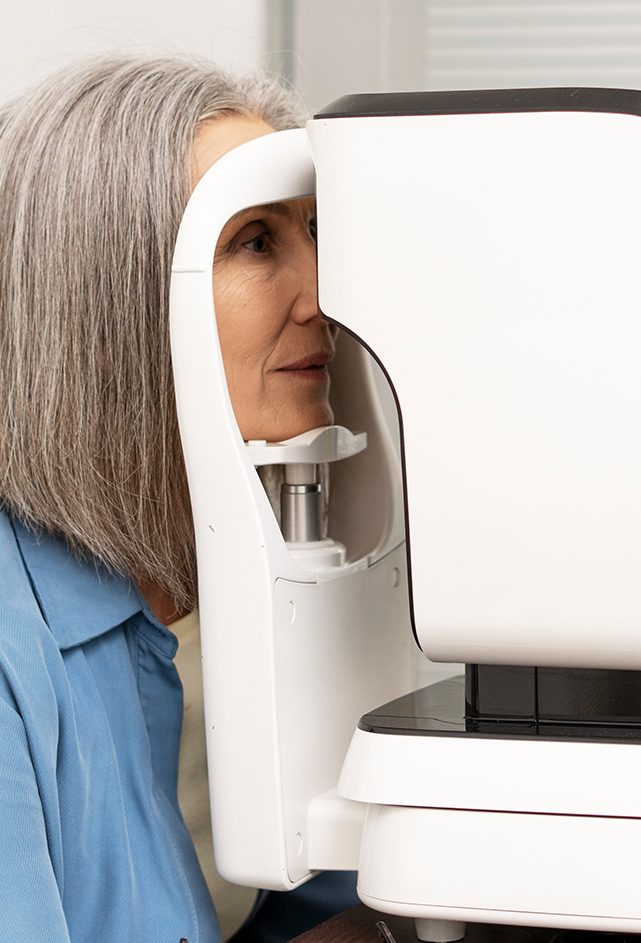
At Vision Source Mandan, we take a proactive At Vision Source Mandan, we take a proactive approach to AMD care, focusing on early detection through advanced diagnostic technology and regular monitoring. Our comprehensive eye exams include specialized testing to identify even the earliest signs of macular changes, often before you notice any vision problems.
We utilize state-of-the-art imaging equipment to capture detailed pictures of your retina and track any changes over time. This technology enables us to closely monitor your condition and make timely referrals to retinal specialists when necessary. While we don’t perform surgical injection interventions, we maintain strong relationships with trusted retina specialists throughout North Dakota to ensure you receive the most appropriate care.
Our AMD management includes:
Regular monitoring appointments to track disease progression
Nutritional counseling and supplement recommendations
Low vision aids and adaptive techniques to maximize remaining vision
Coordination with retinal specialists for advanced treatments
Support and education for patients and families
For patients with wet AMD requiring injections or other specialized treatments, we work closely with ophthalmologists to ensure seamless care coordination. We continue monitoring your overall eye health while specialists address the specific treatment needs of your condition.
Trust Vision Source Mandan
for Your Eye Health
At Vision Source Mandan, we combine decades of experience with cutting-edge technology to provide comprehensive eye care for our community. Our skilled optometrists, Dr. Brittany Schauer, Dr. Danielle Dyke, and Dr. Wayne Aberle, understand the complexities of exfoliation syndrome and work diligently to preserve your vision through early detection and personalized treatment plans.
As part of the respected Vision Source network, we have access to the latest advancements in eye care technology and treatment options. Our commitment to building trusted, long-term relationships ensures your eye health remains our top priority throughout your care journey. Contact us today at (701) 800-7501 or complete our online contact form to discuss your vision concerns and learn more about protecting your eye health.
Testimonials
What Our Clients Say

My annual eye exam is always an excellent experience with Dr. Danielle Dyke. The exam is always thorough, and Dr. Dyke takes the time to explain my eye health in a way I can understand. The Vision Source eye clinic is modern, clean, and the staff is very welcoming. I always feel comfortable and well-cared for at my appointment. I highly recommend Dr. Dyke and Vision Source!
Patricia G.
Dr. Schauer did an amazing job getting my eye infection cleared up. As I sat in my room waiting my turn, because I had a last minute appointment, I could hear her working with a family next door that had young kids.
Fred S.
Whenever I have had eye issues, they have made efforts to get me in asap. Which I really appreciate. I have had Dr. Aberle and Dr. Dyke and they are both excellent. Recently, I saw Dr. Aberle for a chronic eye problem in one eye & he fixed the problem. Honestly, it felt like a miracle. The office staff is also very pleasant to deal with.
Sheila S.
I've literally been a lifelong customer since 5th grade when it was Dr. Little! Dr. Schauer has taken over since Dr. Little retired. It's always a good, friendly experience with all of the staff there. I've never had a bad experience.
Bill S.
The front desk people are very nice and friendly got called in to see Wayne before my appointment time Vision Source has very friendly staff and the clinic is very clean will always be a patient to Vision Source.
Deborah C.
I was greeted by the front desk very efficiently. The person who did the first part of my history and did the testing like the little spritz in my eyes, etc, was very good. I really like my eye doctor, I feel that I get all my questions answered as well as she explains what she is seeing when she is examining my eyes.
Dolly A.

Need to Schedule an Appointment?
WE ARE Accepting New Patients
Your vision is precious—trust it to the experienced team at Vision Source Mandan, where we treat you like family
while providing the highest standard of eye care available in the Bismarck-Mandan area.
MAP

Contact Us
Office Hours
Monday 8:00am - 5:00pm
Tuesday 8:00am - 7:00pm
Wednesday 8:00am - 5:00pm
Thursday 8:00am - 5:00pm
Friday 8:00am - 1:00pm
Saturday Closed
Sunday Closed
* We are closed from 12:00 pm - 1:00pm on the 2nd Thursday of each month for a team meeting.
© 2026 Vision Source Mandan. All Rights Reserved. Accessibility Statement - Privacy Policy - Sitemap
Powered by: 