

People have been using tools to help them see clearly since at least 60 A.D.
Roman philosopher Seneca is recorded to have used a glass globe of water to magnify text, while Emperor Nero would use a magnifying emerald to see gladiator fights better. We no longer need to resort to using water bowls or gemstones, and it’s pretty cool to see how far we’ve come in vision correction since then.
Corrective Lenses Evolving Over the Centuries
In the 10th century in Europe, monks made the next leap forward in corrective lens technology. They needed to be able to see tiny details to do their beautiful illuminated calligraphy, and they discovered that polished domes of transparent quartz worked very well. They called these “reading stones.”
Another couple of centuries would pass before anyone would try attaching reading stones to wearable frames for easier use. We don’t know the identity of the first person to do this, though we often credit Florentinian man Salvino D’armati.
Glasses for the Lower Classes
The earliest spectacles could only be made out of expensive materials like crystal, making them a status symbol for the wealthy but far too pricey for anyone else to afford. As literacy rates skyrocketed across Europe following the invention of the printing press in 1440, demand increased for affordable reading glasses. Production became cheaper when they began using glass for the lenses instead of expensive crystal.
Prescription Lenses and Foldable Frames
Glasses in the next couple of centuries were still pretty limited. The frames had to perch on the nose or be held with a handle, and there was only so much fine-tuning glass blowers could do with the lenses. Correcting for specific refractive errors wasn’t really possible (imagine wearing someone else’s glasses). Then, in the 1700s, temples (the portion extending past the ear) were added and glasses became hands-free.
We give Benjamin Franklin credit for inventing bifocals, which was also when hinges were introduced, making glasses foldable for compact storage. Eye doctors were making headway in tailoring lenses to patients’ specific needs, including the invention of cylindrical lenses for astigmatism in the early 1800s. Finally, Herman Snellen, a Dutch eye doctor, invented the “big E” chart, standardizing vision correction across the field of optometry.
Modern Glasses
We’re incredibly fortunate to have glasses (not to mention contact lenses) that precisely address our vision problems — tailored not just to each patient, but to each eye! And modern glasses don’t just work well, we can choose frames in any shape, color, or material we want to fit our style. We as modern optometrists are proud to stand on the shoulders of giants. We’re happy to help if you need a prescription update so you can pick out your next pair of glasses!
Isn’t it incredible how far glasses have come?
Top image used under CC0 Public Domain license. Image cropped and modified from original.
The content on this blog is not intended to be a substitute for professional medical advice, diagnosis, or treatment. Always seek the advice of qualified health providers with questions you may have regarding medical conditions.
Testimonials
What Our Clients Say

My annual eye exam is always an excellent experience with Dr. Danielle Dyke. The exam is always thorough, and Dr. Dyke takes the time to explain my eye health in a way I can understand. The Vision Source eye clinic is modern, clean, and the staff is very welcoming. I always feel comfortable and well-cared for at my appointment. I highly recommend Dr. Dyke and Vision Source!
Patricia G.
Dr. Schauer did an amazing job getting my eye infection cleared up. As I sat in my room waiting my turn, because I had a last minute appointment, I could hear her working with a family next door that had young kids.
Fred S.
Whenever I have had eye issues, they have made efforts to get me in asap. Which I really appreciate. I have had Dr. Aberle and Dr. Dyke and they are both excellent. Recently, I saw Dr. Aberle for a chronic eye problem in one eye & he fixed the problem. Honestly, it felt like a miracle. The office staff is also very pleasant to deal with.
Sheila S.
I've literally been a lifelong customer since 5th grade when it was Dr. Little! Dr. Schauer has taken over since Dr. Little retired. It's always a good, friendly experience with all of the staff there. I've never had a bad experience.
Bill S.
The front desk people are very nice and friendly got called in to see Wayne before my appointment time Vision Source has very friendly staff and the clinic is very clean will always be a patient to Vision Source.
Deborah C.
I was greeted by the front desk very efficiently. The person who did the first part of my history and did the testing like the little spritz in my eyes, etc, was very good. I really like my eye doctor, I feel that I get all my questions answered as well as she explains what she is seeing when she is examining my eyes.
Dolly A.
Need to Schedule an Appointment?
WE ARE Accepting New Patients
Your vision is precious—trust it to the experienced team at Vision Source Mandan, where we treat you like family
while providing the highest standard of eye care available in the Bismarck-Mandan area.
MAP


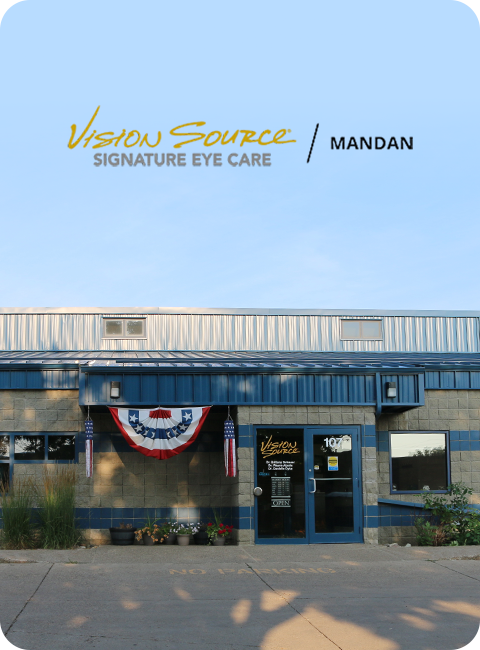
Contact Us
Office Hours
Monday 8:00am - 5:00pm
Tuesday 8:00am - 7:00pm
Wednesday 8:00am - 5:00pm
Thursday 8:00am - 5:00pm
Friday 8:00am - 1:00pm
Saturday Closed
Sunday Closed
* We are closed from 12:00 pm - 1:00pm on the 2nd Thursday of each month for a team meeting.
© 2026 Vision Source Mandan. All Rights Reserved. Accessibility Statement - Privacy Policy - Sitemap
Powered by: 