

20/20 vision is often thought of as perfect eyesight, but it’s really just one part of it.
All it means when someone has 20/20 vision is that they are able to see something clearly from 20 feet away without glasses. They could still be dealing with any number of a wide range of vision problems other than basic refractive errors, all of which are much more likely to remain undiagnosed and untreated.
Do You Have Symptoms of an Undiagnosed Vision Problem?
Some eye problems come with very obvious symptoms, such as lazy eyes or crossed eyes, but most are subtler, particularly in children. Young kids don’t know that what they are experiencing isn’t normal, so it rarely occurs to them to describe it to an adult. All they know is that they are expected to perform at the same level as their peers and that they can’t seem to keep up for some reason. The result is frustrated adults, confused and upset children, and an unfortunate number of misdiagnosed learning disorders.
Symptoms to watch for include:
- Trouble concentrating
- A short attention span (especially for close work)
- Problems with reading concentration
- Frequent headaches
- Neck strain
- Double vision
- Dizziness
- Poor depth perception
- Frequent blinking and rubbing of eyes
Eyes Should Work as a Team
For good eyesight, we don’t just need our eyes to work individually. We also need them to work effectively as a team, which is called binocular vision. You can see how it works by closing one eye, then the other, while focusing on the same object. You’ll notice that you see things from a slightly different angle out of each eye. This is due to the distance between your eyes. Our brains combine the two images into a single 3D one, which is how we can judge distances.
A variety of problems can impede binocular vision:
- Divergence insufficiency. The eyes struggle to turn outward to focus on distant objects.
- Divergence excess. The eyes turn outward too much when focusing on distant objects.
- Convergence excess. The eyes turn inward too much when focusing on close objects.
- Convergence insufficiency. The eyes struggle to turn inward to focus on close objects.
- Strabismus. One eye turns inward or outward.
- Amblyopia (“lazy eye”). The brain will favor input from just one eye, making the other worsen in acuity. This is often the result of a severe refractive error in one eye or strabismus.
- Vertical heterophoria. The eyes are vertically misaligned, making them strain to create a coherent image together.
Most forms of binocular vision dysfunction can be treated through visual therapy or corrected with special glasses, but only if they are diagnosed. Some are best corrected with surgery.
The Importance of Comprehensive Eye Exams
School nurses often give students the big E test, but this only helps them diagnose nearsightedness. Only a comprehensive eye exam can test for other vision problems, and it is critical to a child’s education to catch a vision problem early on. Many adults never received a diagnosis and went through all of their years of school struggling to see. If you think you or your child might have an undiagnosed vision problem, don’t hesitate to schedule an eye exam.
Your clear, comfortable vision is our highest priority!
Top image used under CC0 Public Domain license. Image cropped and modified from original.
The content on this blog is not intended to be a substitute for professional medical advice, diagnosis, or treatment. Always seek the advice of qualified health providers with questions you may have regarding medical conditions.
Testimonials
What Our Clients Say

My annual eye exam is always an excellent experience with Dr. Danielle Dyke. The exam is always thorough, and Dr. Dyke takes the time to explain my eye health in a way I can understand. The Vision Source eye clinic is modern, clean, and the staff is very welcoming. I always feel comfortable and well-cared for at my appointment. I highly recommend Dr. Dyke and Vision Source!
Patricia G.
Dr. Schauer did an amazing job getting my eye infection cleared up. As I sat in my room waiting my turn, because I had a last minute appointment, I could hear her working with a family next door that had young kids.
Fred S.
Whenever I have had eye issues, they have made efforts to get me in asap. Which I really appreciate. I have had Dr. Aberle and Dr. Dyke and they are both excellent. Recently, I saw Dr. Aberle for a chronic eye problem in one eye & he fixed the problem. Honestly, it felt like a miracle. The office staff is also very pleasant to deal with.
Sheila S.
I've literally been a lifelong customer since 5th grade when it was Dr. Little! Dr. Schauer has taken over since Dr. Little retired. It's always a good, friendly experience with all of the staff there. I've never had a bad experience.
Bill S.
The front desk people are very nice and friendly got called in to see Wayne before my appointment time Vision Source has very friendly staff and the clinic is very clean will always be a patient to Vision Source.
Deborah C.
I was greeted by the front desk very efficiently. The person who did the first part of my history and did the testing like the little spritz in my eyes, etc, was very good. I really like my eye doctor, I feel that I get all my questions answered as well as she explains what she is seeing when she is examining my eyes.
Dolly A.
Need to Schedule an Appointment?
WE ARE Accepting New Patients
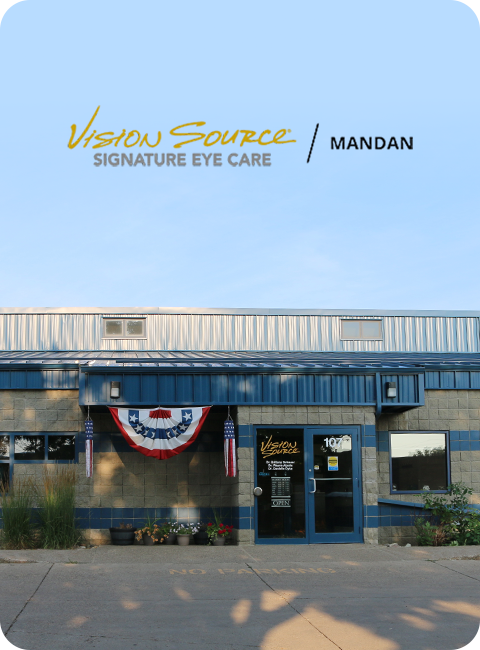
Your vision is precious—trust it to the experienced team at Vision Source Mandan, where we treat you like family
while providing the highest standard of eye care available in the Bismarck-Mandan area.
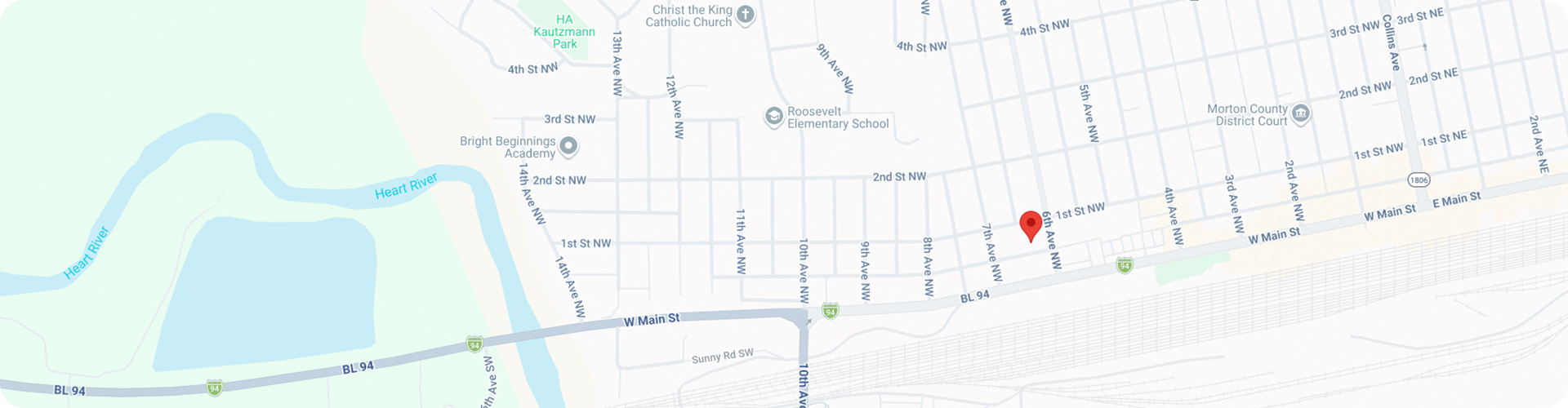
MAP

Contact Us
Office Hours
Monday 8:00am - 5:00pm
Tuesday 8:00am - 7:00pm
Wednesday 8:00am - 5:00pm
Thursday 8:00am - 5:00pm
Friday 8:00am - 1:00pm
Saturday Closed
Sunday Closed
* We are closed from 12:00 pm - 1:00pm on the 2nd Thursday of each month for a team meeting.
© 2026 Vision Source Mandan. All Rights Reserved. Accessibility Statement - Privacy Policy - Sitemap
Powered by: 